
The 2026 Master Guide to Underage Gambling Prevention in South Africa
A Note from Renee Kingsley, Editor
“I have spent nearly thirty years as a casino analyst in South Africa. I’ve watched our industry go from physical tokens in Cape Town casinos to high-speed digital apps that live in your child’s pocket. In 2026, the ‘digital front door’ is harder to guard than ever before. We are no longer just worried about a teen sneaking into a bookie; we are worried about the gamification of their daily digital life. This guide is written in plainspeak to give you the industry-insider tools you need to protect your household.”
— Renee Kingsley
The 2026 Landscape: Why This is Different Now
In April 2026, the gambling environment in South Africa reached a tipping point. While the National Gambling Act of 2004 remains our legal bedrock, the way minors access betting has evolved into a “hidden” crisis.
The RGS Crackdown
Just this month, the National Gambling Board (NGB) issued a major notice regarding Remote Gambling Servers (RGS). These are the systems that allow “instant win” casino-style games to be hidden inside otherwise legal sports betting apps. These games are high-speed and highly addictive, often bypassing the mental barriers a child might have toward a “standard” casino.
The Student Risk
In February 2026, the NGB partnered with NSFAS because of a surge in students using their education allowances to gamble. This confirms what we’ve seen in our industry audits: the transition from “gaming” to “gambling” is happening earlier than ever.
The New Verified Portal
The NGB has launched a Verified Gambling Operators Web Portal. For parents, this is your first line of defence. If a site isn’t on this list, it is illegal, unregulated, and likely has zero protection for your children.
The Legal "Hard Line": It’s Not a Suggestion
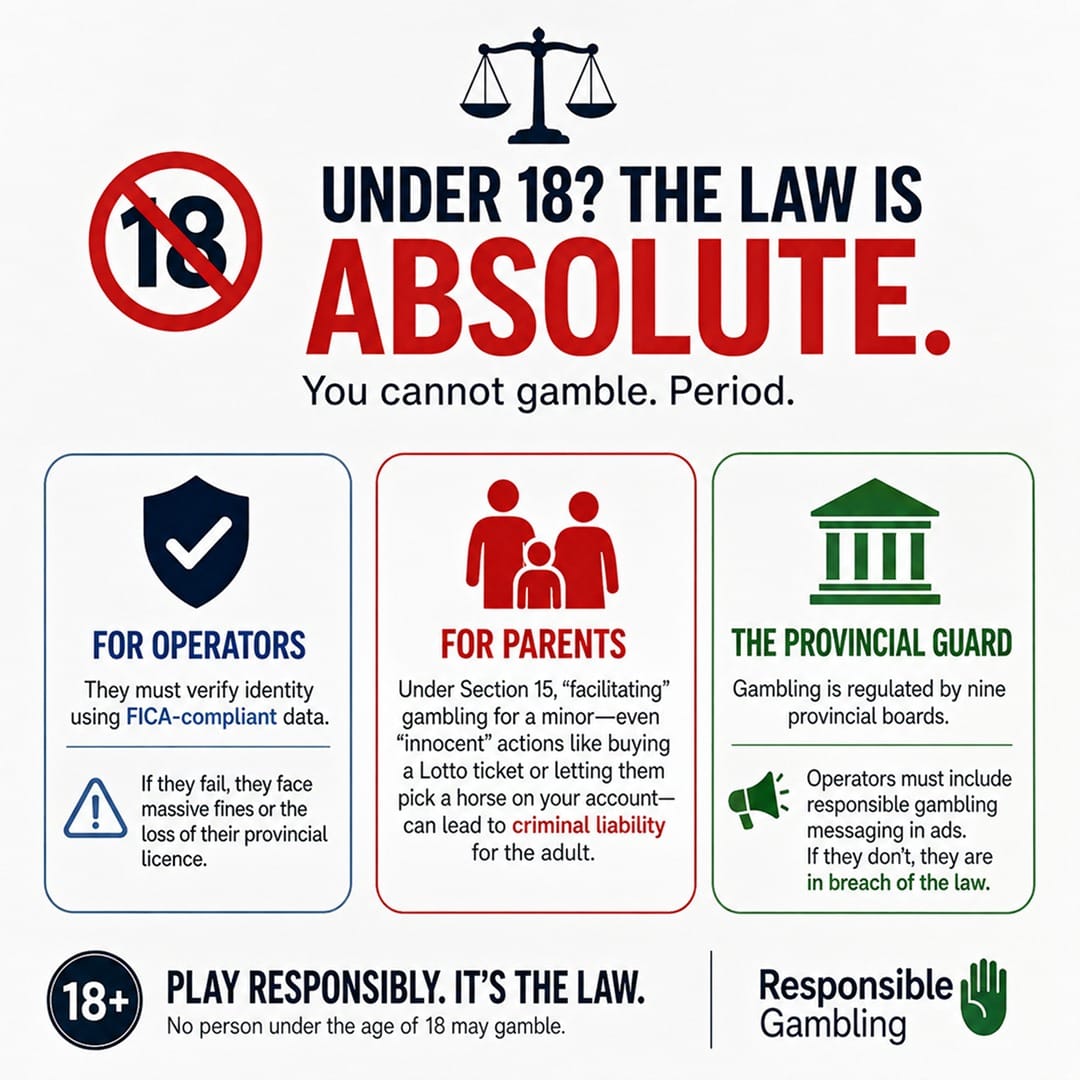
South African law is absolute. If you are under 18, you cannot gamble. Period.
Section 14 & 15 of the National Gambling Act
The law doesn’t just punish the child; it places the burden on the Operator and the Guardian.
- For Operators: They must verify identity using FICA-compliant data. If they fail, they face massive fines or the loss of their provincial licence.
- For Parents: Under Section 15, “facilitating” gambling for a minor—even “innocent” actions like buying a Lotto ticket for a child or letting them pick a horse on your account—can lead to criminal liability for the adult.
The Provincial Guard
Gambling is regulated by nine provincial boards (like the Western Cape Gambling and Racing Board). These boards are the ones who actually issue the licences. When you see a gambling advert on a billboard in Johannesburg or a bus in Durban, that operator has a legal duty to include responsible gambling messaging. If they don’t, they are in breach of the law.
The Science: Why "Willpower" Isn't Enough
One of the biggest mistakes parents make is thinking their child can “just say no.” As an industry analyst, I can tell you that the math and the biology are stacked against them.
- The Executive Function Gap: The Prefrontal Cortex (the part of the brain that weighs risks and says “stop”) isn’t fully developed until age 25.
- The Dopamine Spike: The adolescent brain is wired to seek “novelty” and “high-reward” scenarios. When a minor wins R200 on a random bet, their brain receives a dopamine hit significantly stronger than an adult’s.
- The Priming Effect: Research from Wits University (April 2026) suggests that early exposure to gambling-like mechanics “grooms” the brain. It builds neural pathways that make it much easier to fall into addiction later in life.
The "Trojan Horse": Loot Boxes & Gaming
The most dangerous entry point for South African kids in 2026 isn’t a betting app—it’s Video Games.
What are Loot Boxes?
Found in games like FC 26, Fortnite, or Call of Duty, these are digital crates that a child buys for Rands. They don’t know what’s inside. It could be a rare “skin” or a worthless item.
- Why it’s Gambling: It hits the three pillars of gambling: Consideration (paying money), Chance (the outcome is random), and Prize (the digital item).
- The Industry View: These are “variable reward systems.” They use the exact same psychological loops as a slot machine to keep players spending. If your child is obsessed with “opening crates,” they are being trained for the casino floor.
Identifying the "Digital Breadcrumbs" (Warning Signs)
Underage gambling in the digital age is quiet. You won’t find betting slips under the bed; you’ll find them in the bank statement.
Financial Red Flags
- Capitec & PayShap Transfers: A sudden spike in small transfers (R20, R50) to “friends” or unknown recipients. These are often used to pay “runners”—older peers who place bets on behalf of minors.
- SnapScan/Zapper Activity: Look for payments to “Entertainment” or “Media” companies that don’t match your child’s usual hobbies.
- The “Micro-Charge”: Many illegal offshore sites use generic names on bank statements to hide their identity.
Behavioural Red Flags
- The “Friday Night Shift”: Intense anxiety or excitement specifically around the start of the weekend’s Premier League or Super Rugby matches.
- Hyper-Secrecy: Turning the phone screen away when you enter the room, or a sudden, aggressive need for privacy with their devices.
- Academic Decay: A sudden drop in grades, particularly in subjects that require long-term focus (like Math or Science), as their “mental bandwidth” is taken up by tracking bets.
Your "Technical Fortress" (Step-by-Step)
As an expert, I recommend three tiers of technical protection for every South African household.
Tier 1: Device Lockdown
- Biometrics are Mandatory: Set your betting and banking apps to require FaceID or a Fingerprint. Never allow your phone to “remember” these passwords in a shared browser.
- Logout Protocol: Manually log out of every session. Most minors access betting accounts because a parent left a tab open on the family tablet.
Tier 2: Dedicated Blocking Software
- BetBlocker (Free): This is the best tool for the South African context. It blocks over 80,000 gambling sites and is a non-profit tool that works on all devices.
- GamBlock: If you have a child who is tech-savvy, this is the “nuclear option.” It is kernel-level software that is nearly impossible to bypass or uninstall without an admin password.
Tier 3: Financial Fencing
- Banking Blocks: Banks like Absa and Capitec are now (as of early 2026) using gambling data to monitor financial health. Check your banking app for a “Gambling Block” toggle. Turning this on will decline any transaction coded as gambling.
- Alerts: Set up SMS notifications for every single cent that leaves your account.
The Conversation: How to Talk to Your Teen
Don’t approach this as a police officer; approach it as a consultant.
- The “Rigged” Reality: Don’t tell them gambling is “evil.” Tell them it’s a math problem they are destined to lose. Explain the “House Edge.” Show them that for every R100 spent in a casino, the casino is mathematically guaranteed to keep a percentage.
- The “Dopamine” Talk: Explain how the apps are designed to trick their brains. Use the analogy of a “digital hook.”
- The “Safety Valve”: Make it clear that if they do get into a “hole” (financial debt), they should come to you immediately. The biggest driver of teenage suicide in gambling cases is the fear of admitting a financial loss.
Reporting & Redress: Using the 2026 NGB Tools
If you find a site that let your child sign up, they are breaking the law. Here is how you hold them accountable:
- Check the License: Go to the footer of the website. Identify which Provincial Board issued their licence (e.g., Gauteng Gambling Board).
- Use the NGB Verified Portal: Go to ngb.org.za and use the 2026 portal to see if the operator is even legal. If they aren’t on that list, they are a criminal enterprise.
- File a Formal Dispute: Contact the Provincial Board and provide screenshots of the registration process. The Board has the power to force the operator to return your funds and fine them heavily
Professional Resources: Where to Turn

NRGP Helpline
24/7 Professional Counseling
0800 006 008

NRGP WhatsApp
Real-time chat with a counselor
076 675 0710

SADAG
Mental health & addiction support
0800 567 567

Frequently Asked Questions (FAQ)
No. Even if it is a gift, the purchase of a lottery ticket by or for a minor is illegal in South Africa.
First, lock the card. Second, contact the bank and the gambling operator. While many operators will not refund “authorised” transactions (even if done by a child), reporting the incident helps the operator flag that device for future underage prevention.
No. While no real money is involved, these apps use “simulated gambling” mechanics that normalize the behaviour and often use higher “win rates” than real casinos to give children a false sense of skill.
Editorial Disclosure: Betting.za.com serves as an affiliate platform. We only list and review operators who hold valid provincial licences and strictly adhere to the 2026 NGB guidelines on age verification and FICA compliance. This content is for educational purposes and does not constitute legal or medical advice.