
Fast & Easy FICA Verification: The Ultimate Guide to Withdrawing Casino Winnings in South Africa
Waiting for your casino winnings to clear FICA verification can be frustrating. We get it. You’ve hit a great win, and now you just want your money. However, completing your Know Your Customer (KYC) and Financial Intelligence Centre Act (FICA) checks is the absolute only way to unlock fast, hassle-free withdrawals at South African online casinos.
Instead of looking at FICA as an obstacle, it helps to see it as a digital padlock on your bankroll. This guide will show you exactly how to verify your account quickly, why your documents might be getting rejected, and how to fast-track your next payout.
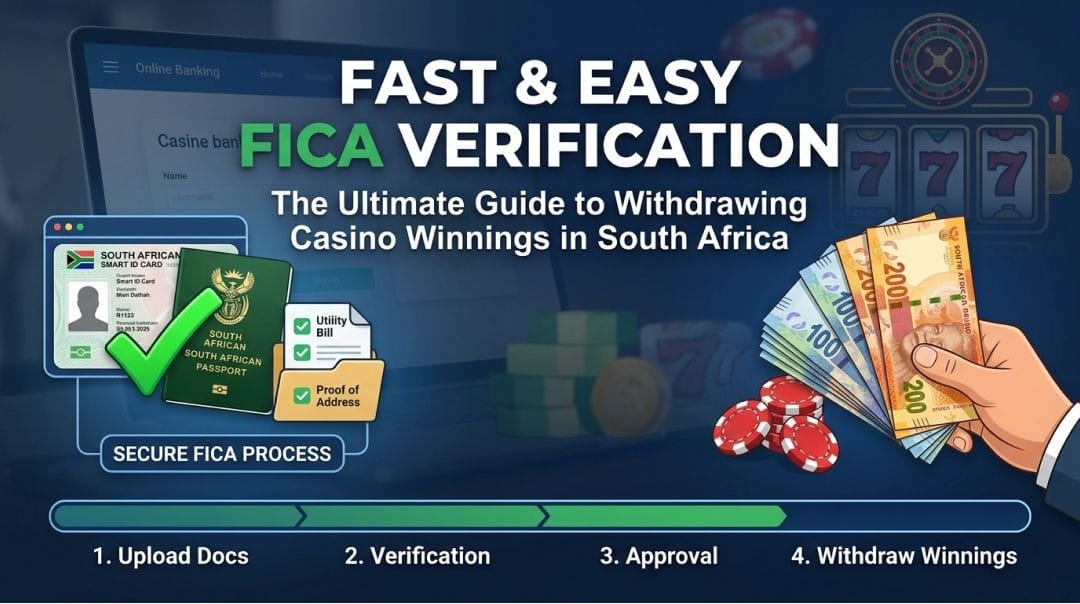
What Are KYC and FICA? (And Why Do Casinos Demand Them?)
Before a licensed online casino can legally pay you, they need to prove two things: that you are who you say you are, and that the money you are playing with is legally yours.
- KYC (Know Your Customer): This is a global standard used by online businesses to prevent identity theft and underage gambling. It simply proves your identity and age.
- FICA (Financial Intelligence Centre Act): This is strict, South African-specific legislation enacted to combat money laundering and tax evasion. All accountable institutions in SA, including banks and licensed betting platforms, must comply with it.
KYC vs. FICA: What’s the Difference?
While they overlap, they serve slightly different purposes for South African players:
| Feature | Standard KYC (Global) | FICA (South Africa Specific) |
|---|---|---|
| Primary Goal | Verify identity and age | Combat money laundering and track illicit funds |
| Mandated By | International gaming commissions | South African Government |
| Documents Required | ID, sometimes Proof of Address | ID, Proof of Address (Strict 3-month rule), and occasionally Proof of Bank Account |
| Trigger Point | Usually upon first withdrawal | Often required immediately upon registration or before any withdrawal |
How to FICA Your Casino Account (The Modern Way)
Gone are the days of scanning documents at an internet cafe and waiting a week for approval. Today, top South African casinos use automated verification systems powered by AI to approve your account in minutes.
Many leading platforms now use “Liveness Checks.” Instead of just uploading a static photo, the casino’s automated system will ask you to upload your ID and then take a real-time selfie using your smartphone camera to ensure you match the document.
Standard Documents You Will Need:
- Proof of Identity: A clear photo of your Green Barcoded ID Book, Smart ID Card (both sides), or valid Passport.
- Proof of Address: A utility bill, retail account statement, or bank statement clearly showing your name and residential address. (Must be less than 3 months old).
Steps to Complete Verification:
- Register: Create your account at your chosen online casino.
- Navigate to Verification/My Profile: Don’t wait for your first withdrawal. Go to the document upload section immediately.
- Upload Documents: Submit clear, uncropped photos of your ID and Proof of Address.
- Clearance: Automated systems usually approve standard documents within 5 to 15 minutes. Manual reviews may take 24 to 48 hours.
Why Did My FICA Fail? (Common Rejection Reasons & Fixes)
If your documents were rejected, don’t panic. Automated systems are incredibly strict about image quality. Here is why your FICA likely failed and how to fix it immediately:
- The 4-Corner Rule: Your photo of your ID or utility bill must show all four corners of the document. If you crop out the edges, the system assumes it’s tampered with and auto-rejects it.
- Flash Glare & Blurriness: A camera flash obscuring your face, the ID number, or the barcode will result in an instant fail. Ensure you take the photo in natural light.
- Outdated Bills: Your proof of address must be strictly under 3 months (90 days) old. A bill from 4 months ago will not work.
- Name Mismatches: The name on your casino account must perfectly match the name on your bank account and ID. If your ID says “Johannes” but you registered as “Johan,” you will face delays.
- Digital Bank Statements: If you are using a digital bank statement from FNB, Capitec, Standard Bank, or Absa as your proof of address, do not take a screenshot of your banking app. You must download the official, stamped PDF statement and upload that file.
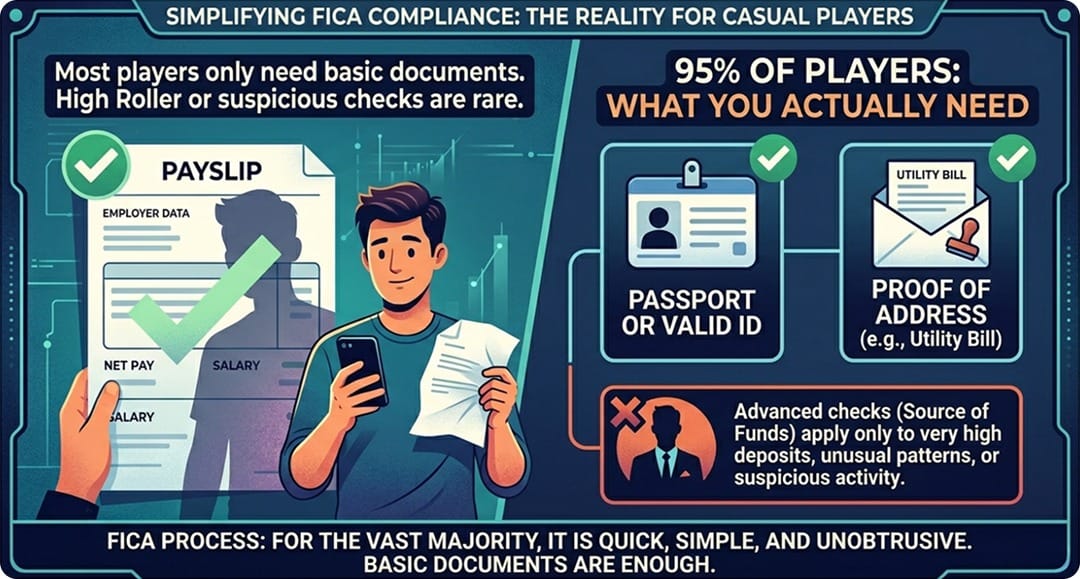
The "Source of Funds" Myth: Do I need to show my payslip?
When reading about FICA, many players worry that they will have to hand over trust deeds, pension slips, or sensitive tax documents just to play slots.
Here is the reality: For 95% of casual players, a standard FICA check only requires your ID and a Proof of Address.
Casinos usually only trigger advanced “Source of Funds” checks if you are a high roller, making unusually large deposits, or if there is suspicious activity on the account. Unless you are depositing massive sums of money straight out of the gate, your FICA process will be quick, simple, and unobtrusive.
Claiming FICA Bonuses
Because South African casinos want you fully verified and ready to play, many offer FICA Bonuses. These are essentially no-deposit bonuses—like free spins or a small cash credit—given to you strictly as a reward for successfully uploading and verifying your documents. Always check the promotions page to see if your chosen casino offers a reward for verifying your account early!
Our Expert Advice
“Don’t wait until you hit a massive jackpot to submit your FICA documents. South African casinos legally cannot process your withdrawal until you are verified. My advice? Upload your ID and proof of address the exact moment you open your account. It takes 5 minutes upfront, ensures you qualify for FICA bonuses, and guarantees your winnings hit your bank account without agonizing delays when you want to cash out.”
— Insert Writer’s Name here
Frequently Asked Questions (FAQ)
If the casino uses an automated AI system (like a Liveness Check), your FICA can be approved in under 10 minutes. If the documents require a manual review by the support team, it typically takes between 24 and 48 hours.
At many casinos, yes. You can often register, deposit, and play games without completing FICA. However, you will be completely blocked from withdrawing any winnings until your verification is 100% complete.
Yes, provided you are playing at a licensed and reputable casino. Regulated casinos use advanced SSL encryption to protect your data and are legally bound by strict data privacy laws (like POPIA in South Africa) regarding how they store your sensitive documents.
The most reliable documents are municipal water/electricity bills, official bank statements, or retail account statements (like Edgars or Woolworths), provided they clearly show your name, residential address, and an issue date within the last 3 months.