
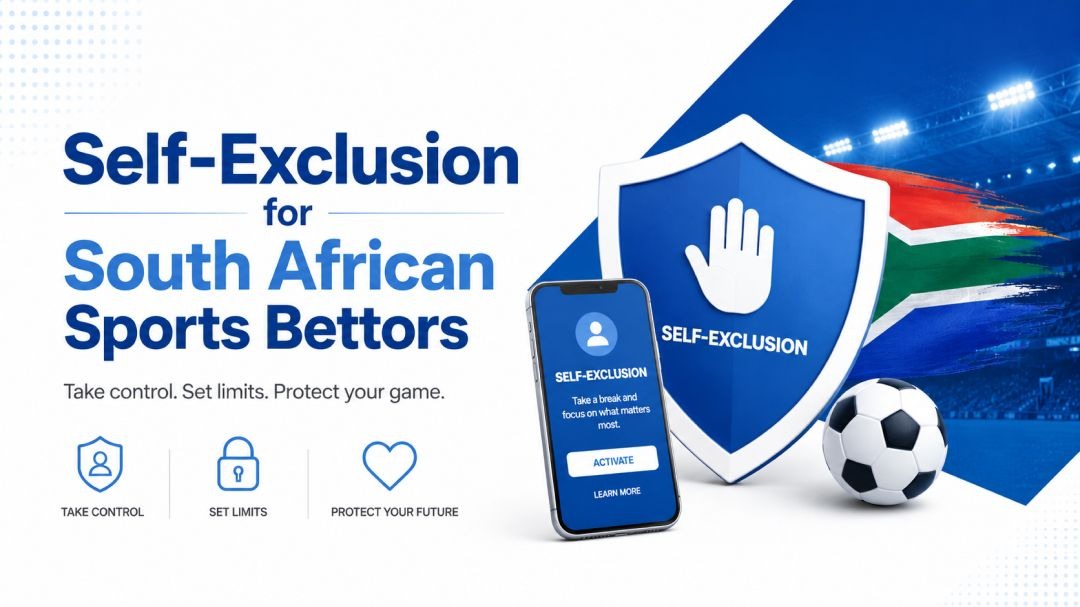
Self-Exclusion for South African Sports Bettors
Placing a bet on a rugby match or following your accumulator through a live soccer game is exciting. But there are times when that excitement tips into something less enjoyable — chasing a loss, betting more than you planned, or finding it hard to switch off after a bad week of results. Self-exclusion is the tool that puts a firm, enforceable stop on your account when you decide you need one.
This page covers everything South African sports bettors need to know about self-exclusion: how it works, what happens to your pending bets, how to do it across the operators we list, and what the 2026 regulatory changes mean for you as a player.
Why Self-Exclusion Matters for Sports Bettors
Sports betting has a few features that make it particularly intense compared to other forms of gambling — and understanding those features is the first step to knowing when self-exclusion might be the right call.
Live in-play betting is the obvious one. When you can place a new bet every few minutes during a match, the pace of decision-making is completely different from buying a weekly lottery ticket. A bad first half can trigger a string of in-play bets you would never have placed in a calmer moment. Cash-out prompts arrive at emotionally charged points in a game. Accumulators that nearly come in create a powerful near-miss effect that pushes many punters straight back to the bet slip.
Sports betting also carries a layer of skill illusion that pure casino games do not. It is easy to convince yourself that your rugby knowledge or your reading of PSL form gives you an edge — and that edge becomes a justification for betting more than planned. The research on chasing accumulator near-misses in particular shows how quickly recreational betting can become compulsive betting.
None of this means sports betting is dangerous for most people. The overwhelming majority of punters enjoy it as exactly what it is: entertainment with a financial stake. But self-exclusion exists because the line between fun and a problem can move faster in a live betting environment than almost anywhere else — and having a reliable way to draw that line matters.
Self-exclusion is not only for people who have developed an addiction. Many punters use it after a losing run, during a period of financial stress, or simply to take a season off. It is a responsible, practical tool that anyone can use at any time.
What Self-Exclusion Actually Does at a Sports Betting Site
Self-exclusion is a formal, binding request to a licensed operator to close your access to their platform for a defined period. Once it is in place, the operator is legally required to honour it. This is not a voluntary guideline — it is a condition of their provincial licence.
When you self-exclude from a South African licensed sports betting site, the operator must:
- Block you from logging into your account immediately
- Prevent any new account being opened in your name or with your identity details
- Remove you from all promotional communications, including SMS tips, email bonuses, and push notifications
- Refund any available balance in your account to you
- What happens to bets placed before exclusion?
Any bets you placed before the exclusion was confirmed are generally settled normally. If your accumulator was running before you made the request, it will be settled when the matches complete. The exclusion covers new betting activity from the point of confirmation onwards.
- What about the casino section of a sports betting site?
Most South African operators run a combined sportsbook and casino under a single account. When you self-exclude, the exclusion typically applies to the entire platform, including slots, live casino, and any other product under that licence. It is worth confirming this with the operator at the time of your request, since a small number of sites operate their casino and sportsbook under separate licences — in which case you may need to make separate exclusion requests.
- What about free bet balances?
Unused free bets and bonus funds are generally forfeited when a self-exclusion is applied. This is standard across all licensed operators and is set out in their terms and conditions.
- When the exclusion ends, does your account reopen automatically?
No. Self-exclusion does not expire and reopen your account on its own. You have to contact the operator to request reinstatement, and most will require a waiting period of at least 24 hours between your request and reactivation. Some impose a longer review period.
Self-Exclusion vs Timeout vs Stake Limits
There are several responsible gambling tools available at licensed South African betting sites. They suit different situations, and choosing the right one matters.
| Tool | Typical Duration | Reversible? | What It Covers | Best Suited To |
|---|---|---|---|---|
| Stake Limit | Ongoing | Yes, with a delay | Maximum bet amount per wager | Keeping individual bets under control while continuing to play |
| Loss Limit | Daily, weekly, or monthly | Yes, with a delay | Total losses over the set period | Managing your overall spend without stopping play |
| Session Timeout / Cooling-Off | 24 hours to 6 months | No (until it expires) | Full account access | Taking a structured break with a defined end date |
| Self-Exclusion | 6 months to permanent | No, or only after a waiting period and review | Account access, re-registration, and all marketing | A firm, enforceable stop when other tools have not been enough |
For sports bettors, stake and loss limits are often the first tool to reach for. Setting a maximum bet per wager or a weekly loss cap means you can carry on enjoying your betting without the risk of a single bad session doing significant damage.
A session timeout suits punters who want a deliberate break — perhaps for the off-season, or after a particularly frustrating run of results — and who are confident they will be ready to return when the period ends.
Self-exclusion is the appropriate step when you are concerned that a shorter, reversible break would not hold. The key difference is that self-exclusion puts the decision out of your hands for the duration. You cannot log in at 11pm during a Champions League night and decide you are ready to start again. That friction is the point.
The 2026 Regulatory Changes and What They Mean for You
In February 2026, the Department of Trade, Industry and Competition published draft amendments to the National Gambling Regulations in Government Gazette No. 54106. Betting.za.com reviewed and publicly supported these amendments, which strengthen the voluntary exclusion system and tighten compliance requirements for licensed operators.
The proposed changes are significant for players. The draft regulations look to make the national self-exclusion register more robust, require faster operator response times to exclusion requests, and introduce stronger penalties for operators who allow self-excluded players to continue gambling or receive promotional material.
In practical terms, this means the system you use when you self-exclude should become more reliable and more consistently enforced across operators, whether you are applying through an individual bookmaker or through the national register. Operators who fail to honour exclusions will face more serious regulatory consequences under the proposed framework.
The amendments were in the consultation phase at the time of publication. Check the Department of Trade, Industry and Competition website or the National Gambling Board at ngb.org.za for the latest on their status.
How to Self-Exclude at SA Sports Betting Sites
Every operator we recommend holds a provincial licence and is legally required to offer self-exclusion. The steps below cover a selection of the bookmakers currently listed on this site. Because we add new operators regularly, the process for any site not shown here will follow the same general pattern: contact support via live chat or email, state that you want to self-exclude, specify the period, and get written confirmation before ending the conversation.
Hollywoodbets
Hollywoodbets is South Africa’s most established bookmaker and one of the most accessible for self-exclusion. Log in and go to My Account > Responsible Gambling > Self-Exclusion to apply directly through your account settings. You can choose a period from one month to permanent exclusion. Alternatively, reach support via live chat or email at [email protected]. The exclusion covers both the sportsbook and casino under your account.

R25 Free Bet On Sign Up


10bet
Contact 10bet’s customer support team via live chat on the website or app, or by email at [email protected]. Tell them clearly that you want to self-exclude and confirm the duration. Their team is available around the clock. Once processed, you will receive written confirmation and your account will be blocked across all products.

100% up to R5,000


ZARbet
ZARbet handles exclusion requests through their live chat support or via direct email. State your request, confirm the period you are applying for, and ask for email confirmation before the chat ends. The exclusion applies across all ZARbet products under your account, including the sportsbook and casino sections.

50 Free Spins on Big Blue Fishing
200% match bonus up to R2000


YesPlay
Reach YesPlay through the live chat on their website. Request self-exclusion, confirm the period, and verify that the exclusion covers their full product offering. YesPlay is licensed in the Western Cape and is required under that licence to remove you from all promotional contact immediately upon the exclusion being applied.

100% bonus up to R3,000


Jabulabets
Contact Jabulabets via live chat or email to request exclusion. Some account settings may also carry a direct responsible gambling option. Permanent exclusion closes the account fully and flags your details to block re-registration.

30 Free Spins On Sign-Up
R35,000 Match Bonuses Over 3 Deposits.


Pantherbet
Self-exclusion at Pantherbet is managed through their live chat support team. Contact them, confirm the exclusion period, and save the chat transcript or confirmation email you receive. Keep this record in case you need to refer back to it.

Get up to R15,000 + 450 Bonus Spins
Easybet
Contact Easybet via live chat or email and state your self-exclusion request. Easybet is obligated under its licensing conditions to process the request without delay. Confirm the period and ask for written confirmation before the conversation closes.

R50 Sign Up Bonus plus 25 Free Spins On Sign-Up
1,500 to R5,000
Apexbets
Apexbets handles exclusion through their customer support channels. Contact them by live chat on the Apexbets website, request exclusion, and confirm the duration. As with all provincially licensed operators, they are required to act on the request promptly.

20 Free Spins + R25 Free Sports Bet
Up to R30,000 across 5 deposits
Practical tip: When you make any self-exclusion request, always ask for confirmation in writing — either an email or a saved chat transcript. This is your record if there is ever a question about when the exclusion was applied or what it covers. If an operator delays or refuses your request, that is a reportable breach of their licence conditions. You can escalate to the relevant provincial gambling board.
Self-Exclusion and Mobile Betting Apps
Most South African punters bet on mobile, and a few things about mobile betting and self-exclusion are worth knowing clearly.
- Deleting the app is not the same as self-excluding.
If you remove the Hollywoodbets or 10bet app from your phone, your account remains open. You can reinstall the app and log in again immediately. The only thing that closes account access is a formal self-exclusion request processed by the operator.
- Push notifications during exclusion.
When self-exclusion is applied, the operator is required to remove you from all marketing, which includes push notifications. If you continue to receive promotional notifications after your exclusion is confirmed, contact the operator and the relevant provincial gambling board. Continuing to push promotional content to a self-excluded player is a licensing breach.
- Logging in via browser.
Self-exclusion is applied to your account, not to a specific device or app. Even if you clear your phone and try to log in through a browser, your credentials will be blocked. The exclusion is tied to your identity and account, not to how you access the site.
- Trying to register a new account during exclusion.
Licensed operators are required to cross-check new registrations against their exclusion records. If you attempt to open a new account using your own identity details during an active exclusion, the registration should be declined. If it is not, that is a reportable breach.
The National Exclusion Register
Excluding yourself from one operator does not cover others. If you self-exclude from 10bet, you can still access your Hollywoodbets account. For punters who hold accounts across several bookmakers — which is common among those who shop for the best odds — the National Responsible Gambling Programme (NRGP) operates a national register that addresses this.
By registering with the NRGP, you can request that your exclusion be communicated to all participating licensed operators at once. This is the most comprehensive option available.
How to register:
- Phone: 0800 006 008 (toll-free, 24 hours a day, 7 days a week)
- Website: responsiblegambling.org.za
You will need to provide identity details so that operators can verify your registration against new account applications. All information is handled confidentially.
One limitation to be aware of: participation in the national register is voluntary for operators and is not yet universal. For full coverage, register with the NRGP and contact each operator individually at every site where you hold an account.
Getting Help
Self-exclusion is a practical first step, but it is not a substitute for professional support if betting has become a serious problem. The following organisations offer free, confidential help to South Africans.
National Responsible Gambling Programme (NRGP) 0800 006 008 | 24 hours a day, 7 days a week | toll-free responsiblegambling.org.za Counselling, referrals, and access to the national exclusion register.
Gamblers Anonymous South Africa Peer support groups run by people with lived experience. Meetings are held in person and online across the country.
Gauteng: 071 377 2746
KwaZulu-Natal: 031 209 6359
Western Cape: 074 837 4001
For a broader look at responsible betting practices, including how to set budgets and recognise problem patterns early, see our Responsible Gambling page.
Frequently Asked Questions
At most South African operators, your sportsbook and casino run under a single account and a single licence, so self-exclusion covers the whole platform. However, a small number of sites split their products across separate licences, which could mean separate exclusions are needed. Always confirm this with the operator when you make your request.
Bets placed before the exclusion was applied are generally settled in the normal way. If your accumulator has legs still to run, those will be settled when the matches complete. The exclusion prevents new bets from the point of confirmation — it does not cancel bets you had already placed.
Yes, unless you register with the NRGP national register, which notifies participating operators simultaneously. Even then, it is good practice to contact each operator directly as well, since not all licensed bookmakers participate in the national register at this stage.
No. Removing the app from your device does not affect your account in any way. You need to contact the operator directly and request a formal self-exclusion.
Yes. Self-exclusion closes your betting account — it does not restrict what websites or sports content you can view. Following scores, reading match previews, and watching live sport is completely unaffected.
They are not permitted to. Once a self-exclusion is confirmed, the operator must remove you from all marketing immediately, including email, SMS, and push notifications. If promotional material continues to arrive after your exclusion is applied, contact the operator and, if it continues, report it to the relevant provincial gambling board.
No. Self-exclusion is not reversible during the agreed period. When the period ends, you must actively contact the operator to request reinstatement. Most will then apply an additional waiting period before reactivating access.
Licensed operators are required to check new registrations against their exclusion records. If you attempt to register using your own details during an active exclusion, the application should be rejected. If a site allows you to open a new account during an active exclusion, it is committing a licensing breach that you can report to the relevant provincial gambling board.
Helpline numbers and regulatory contacts are verified at time of publication.
Gambling can be addictive. Please play responsibly. Toll-free helpline: 0800 006 008.