
Your Rights as a Sports Bettor in South Africa
Placing a bet involves more than picking a winner. You’re entering into a financial agreement with a bookmaker — one that comes with terms, obligations, and potential disputes. Understanding your rights as a bettor means you’re less likely to be caught off guard when something goes wrong, and better equipped to push back when an operator isn’t playing fair.
This guide covers everything South African sports bettors need to know: from odds transparency and account restrictions to withdrawal rights and what to do when a bookmaker voids your bet.

Get up to R15,000 + 450 Bonus Spins


100% up to R5,000


50 Free Spins on Big Blue Fishing
200% match bonus up to R2000


R25 Free Bet On Sign Up



50 Habanero Bonus Spins & R50 When You Sign Up


100% bonus up to R3,000


30 Free Spins On Sign-Up
R35,000 Match Bonuses Over 3 Deposits.

20 Free Spins + R25 Free Sports Bet
Up to R30,000 across 5 deposits

R50 Sign Up Bonus plus 25 Free Spins On Sign-Up
1,500 to R5,000

100% Match Up To R3,000 + 50 Free Spins
1,400+ Games & 800+ Slots



100% Deposit Match Up to R3,000
100% Welcome Bonus Up to R3,000

100% to R5,000 + 250 free spins + R25 bonus bet
23 Sports Categories, 700+ Casino Games

250% Welcome Bonus up to R5,000
250% to R5,000 + 50 FS (BZC exclusive)

100% Welcome Bonus up to R5,000
100% to R5,000 + 50 Free Spins
The Right to Bet with a Licensed Bookmaker
Before anything else, you have the right to know whether the bookmaker you’re using is properly licensed and accountable to a regulatory authority.
South Africa has a well-established land-based betting regulatory framework, but online sports betting exists in a legal grey area. The National Gambling Act of 2004 prohibits domestically licensed interactive gambling, yet millions of South Africans legally access internationally licensed bookmakers every day. The law targets operators, not bettors — so placing bets online is not a criminal offence for players.
What this means in practice is that most online bookmakers serving South African customers hold licences from offshore jurisdictions. The most reputable of these include:
- Battle of the Boots – pick your side, claim the code, deposit R150 and receive free kicks on your selected slot.
- Laduma Ladder – deposit, place your bets and unlock bigger rewards as you move up the ladder.
- Football Fever Fridays – enjoy a weekly match offer and Free Spins combo every Friday, with a minimum deposit of R250.
- Football Fever Scores – every goal South Africa scores rewards eligible players with 20 Free Spins on Football Fever.
- Football Fever Jackpot – wager on qualifying games for a chance to trigger the weekly jackpot.
A valid licence from a reputable authority means the bookmaker has been assessed for financial stability, fair practice, and complaint handling. Always check the licence before depositing. It should be displayed clearly in the footer of the bookmaker’s website, including the licence number and a link to verify it.
If a bookmaker cannot confirm who regulates it, or if the only licence it holds is from a jurisdiction with minimal oversight, that is a meaningful risk to your funds.
The Right to Clear and Accurate Odds
Odds are the price of a bet, and you have the right to know exactly what price you’re getting before your bet is confirmed.
What bookmakers are required to do
- Display odds clearly and without ambiguity before you confirm a wager.
- Honour the odds at which a bet was accepted, unless a clearly stated rule applies (such as an obvious error — see below).
- Not change the odds on a bet after it has been accepted and confirmed.
Palpable errors (palp errors)
Most bookmakers include a clause in their terms allowing them to void bets placed at odds that were clearly incorrect — for example, if a team with a realistic chance of winning was priced at 50/1 due to a data feed error. This is known as a “palpable error” or “palp” rule.
You have the right to understand this rule before you bet. The criteria for what constitutes a palpable error should be clearly defined in the bookmaker’s terms, not applied selectively or retrospectively to any winning bet that simply surprises the operator.
Best odds and line shopping
You are under no obligation to bet with only one bookmaker. Comparing odds across multiple platforms before placing a bet is completely within your rights and is a sound approach to getting the best value. Some South African bettors use odds comparison tools for this purpose.
The Right to Fair Bet Settlement
Once the event you’ve bet on is over, your bet should be settled accurately and promptly according to the bookmaker’s published rules. This sounds simple, but bet settlement is one of the most frequent sources of disputes between bettors and bookmakers.
Settlement rules
Every bookmaker publishes sport-specific and market-specific settlement rules. You have the right to access these rules before placing your bet — not just after a dispute arises. Key things to check:
- Abandoned or postponed events
Most bookmakers void bets if a match is abandoned before a certain point, but rules vary. Some bookmakers settle on the result at the time of abandonment; others void automatically.
- Overtime and extra time
In markets like “90-minute result,” goals scored in extra time do not count. Make sure you know whether your bet covers full time only or includes additional periods.
- Player and team markets
If a player does not take part in a match, most bookmakers will void that player’s individual bets. Confirm the rule before placing.
- Resulting errors
If a bookmaker settles a bet incorrectly and you receive a payout you weren’t entitled to, they can reclaim it. Conversely, if they settle incorrectly against you, you have the right to have this corrected.
In-play bets
Live betting moves quickly, and disputes around in-play markets are common. Bookmakers typically include a clause allowing them to void in-play bets placed after a relevant event has occurred but before the odds were updated — for example, a goal that was scored before your bet was confirmed. Again, this rule should be clearly defined and applied consistently, not used as a blanket excuse to cancel winning live bets.
The Right to Withdraw Your Money
Your right to withdraw funds from your betting account is one of the most important — and one of the most frequently tested — rights you have as a bettor.
What you're entitled to
- Prompt processing
Reputable bookmakers process withdrawals within a stated timeframe, typically between 24 hours and 5 business days depending on the method. Delays beyond this without explanation are not acceptable.
- Your preferred withdrawal method
In most cases you should be able to withdraw via the same method you used to deposit. South African bettors commonly use EFT, Ozow, or bank transfer.
- Full access to your own funds
A bookmaker cannot withhold your deposited funds without a specific, documented reason related to fraud, bonus abuse, or a regulatory requirement.
- Clarity on verification requirements
Most bookmakers require identity verification (KYC) before processing your first withdrawal. You have the right to know upfront exactly which documents are required and how long verification takes.
When a bookmaker can delay or decline a withdrawal
Legitimate reasons a bookmaker might delay a withdrawal include:
- Pending KYC verification for a new account
- An open bonus with active wagering requirements on the funds in question
- A security review triggered by unusual account activity
What is not acceptable is a bookmaker indefinitely delaying a withdrawal without communication, repeatedly requesting documents you have already provided, or inventing new requirements after a large win. If this happens, escalate the complaint formally.
The Right Not to Have Your Account Arbitrarily Restricted
This is arguably the most contentious area of player rights in sports betting — and the one where the industry’s obligations to bettors are least clearly defined.
Account restrictions and closures
Bookmakers are private businesses and, in most jurisdictions, retain the right to limit stakes, reduce maximum bet amounts, or close accounts at their discretion. This is a commercial reality that most experienced sports bettors eventually encounter, particularly if they bet successfully over time.
However, you still have rights in this situation:
- You must be allowed to withdraw your existing balance
A bookmaker that restricts or closes your account must allow you to withdraw any funds held in your account. Withholding a balance when closing an account is not permissible.
- You are entitled to a reason
While bookmakers are not always required to provide detailed explanations for commercial decisions, a reasonable explanation should be available on request.
- Restrictions should not be applied retroactively to accepted bets
If a bet was accepted and confirmed, the bookmaker cannot later reduce the payout on that bet because they’ve since decided to limit your account.
Bonus abuse and voided winnings
If a bookmaker voids your winnings on the grounds of bonus abuse or breach of promotional terms, you have the right to:
- A clear explanation of which specific term was breached
- Access to the relevant term that was in place at the time you claimed the offer
- A formal complaints process if you dispute the decision
Bookmakers cannot void winnings simply because an amount is larger than expected. The terms justifying the decision must be specific, pre-existing, and genuinely applicable to your situation.
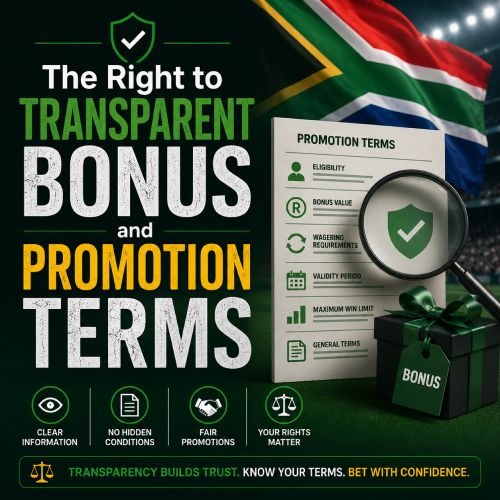
The Right to Transparent Bonus and Promotion Terms
Promotions — welcome bonuses, free bets, enhanced odds, accumulator insurance — are central to the sports betting experience. They are also a significant source of disputes and disappointment when terms aren’t read carefully or aren’t clearly written.
You have the right to understand exactly what you’re agreeing to before activating any offer. Before claiming a betting promotion, check for:
- Minimum odds requirements
Most free bets and enhanced odds offers require your bet to be placed at a minimum price — commonly evens (2.00) or higher. Bets placed at shorter odds typically won’t qualify. - Wagering or rollover requirements
Some bonus funds must be turned over a certain number of times before they can be withdrawn. A “5x rollover” on a R500 free bet means you need to place R2,500 in qualifying bets before any winnings become withdrawable. - Single bet vs accumulator restrictions
Some offers apply only to single bets, others only to accumulators. Some enhanced odds promotions are limited to one market or one event. - Expiry dates
Free bets and bonus funds typically expire within a defined window — often 7 to 30 days. If you don’t use them in time, they are forfeited. - Maximum payout from promotional bets
Some bookmakers cap the winnings you can take from a free bet. A R100 free bet at 10/1 might only pay out R200 rather than the full R1,000 if there’s a maximum payout clause.
Promotions should be clearly advertised with full terms visible before you click “claim” — not buried in a separate terms document or displayed only after the offer is activated.
The Right to Responsible Gambling Tools
Licensed bookmakers are required to provide tools that allow you to manage your betting behaviour. These aren’t optional extras — they are a regulatory condition of operating responsibly.
As a bettor, you have the right to access:
- Deposit limits
Set a maximum on how much you can deposit per day, week, or month. These should take effect immediately and cannot be increased without a mandatory waiting period. - Loss limits
A cap on losses within a defined period, giving you control over your worst-case outcome. - Bet limits
The ability to restrict the maximum size of individual bets you can place. - Session and time limits
Automatic logouts or reminders after a set period of betting activity. - Cool-off periods
Short-term self-imposed breaks (from 24 hours to several weeks) during which you cannot deposit or bet. - Self-exclusion
The right to exclude yourself from the platform entirely, either for a defined period or permanently. Self-exclusion requests should be processed quickly, and the bookmaker must stop all marketing communications to you immediately after exclusion is applied.
If you’re struggling to stay within limits you’ve set for yourself, or if betting is causing financial or personal problems, the South African Responsible Gambling Foundation (SARGF) offers free, confidential support.
SARGF Helpline: 0800 006 008 — free, 24/7
The Right to Raise a Complaint
If you have a genuine dispute with a bookmaker and direct communication hasn’t resolved it, you have the right to escalate through formal channels.
- Step 1: Put it in writing to the bookmaker
Contact the bookmaker’s customer service team by email (not just live chat) so you have a documented record. State your complaint clearly, include relevant dates, bet IDs, and screenshots where possible, and specify the outcome you’re seeking. Most bookmakers commit to a response within a defined timeframe — typically 5 to 14 days.
- Step 2: Escalate to the licensing authority
If the bookmaker’s response is unsatisfactory or they fail to respond within their stated timeframe, escalate to the regulatory body listed in their licence:
- Malta Gaming Authority: mga.org.mt
- eCOGRA (dispute resolution): ecogra.org
- IBAS (Independent Betting Adjudication Service): ibas-uk.com
- Step 3: Use an independent ADR service
Many licensed bookmakers are required to provide access to an Alternative Dispute Resolution (ADR) service. eCOGRA and IBAS are the most commonly used for sports betting disputes. These services review the evidence from both sides and issue a decision — typically binding on the operator.
- Step 4: Community and public forums
While not a formal escalation route, publishing a detailed account of your dispute on recognised forums such as Casinomeister or AskGamblers can be effective. Reputable bookmakers monitor these platforms and are often more responsive to public complaints than private ones.
The Right to Know South Africa's Betting Laws
South Africa has a functioning legal framework for sports betting, though online betting specifically sits in complicated territory.
- Land-based and licensed online betting
Sports betting conducted through operators holding a South African provincial licence is legal. Operators like Hollywoodbets, Supabets, and World Sports Betting hold provincial licences and are regulated domestically. These operators are subject to South African consumer protection law, which gives you stronger recourse in the event of a dispute.
- Offshore online betting
The majority of online-only international bookmakers — including many popular platforms — are not licensed in South Africa. The National Gambling Act’s prohibition on interactive gambling applies to operators, not to individual bettors. Placing bets with an offshore bookmaker is not a criminal offence for the player, but it does mean that SA consumer protection law may not directly apply to your dispute.
Practical implications for bettors
- Disputes with SA-licensed operators can be escalated to the relevant Provincial Gambling Board
- Disputes with offshore operators are handled through the bookmaker’s own complaints process and their licensing authority abroad
- Your funds at an offshore bookmaker are not protected by South African law if the operator becomes insolvent — this is one reason why licence quality matters
FAQs
In most cases, no — a confirmed bet is a contract. The main exceptions are palpable errors (clearly incorrect odds due to a data feed fault) and bets placed after an event has already started or a key event has occurred (in live betting). These exceptions should be clearly defined in the bookmaker’s terms before you bet.
First, check whether your account is fully verified (KYC complete) and whether any bonus wagering requirements apply to your balance. If neither applies and the delay exceeds the bookmaker’s stated processing time, contact support in writing and request a specific reason and timeline. If you don’t receive a satisfactory response, escalate to the licensing authority.
Unfortunately, yes — bookmakers can restrict or close accounts for commercial reasons, including consistent profitability. This is a widely criticised industry practice. What they cannot do is withhold your existing balance. You must be allowed to withdraw any funds in your account regardless of why the account is being closed.
Free bets are promotional credits, not cash. They allow you to place a bet without risking your own money, but the stake itself is not returned if the bet wins — only the winnings are. For example, a R100 free bet on a 3/1 winner pays R300, not R400. Specific terms vary by bookmaker.
Escalate to the Provincial Gambling Board in the province where the bookmaker is licensed. Contact details for each board are available through the National Gambling Board at ngb.org.za.
KYC (Know Your Customer) is the identity and address verification process bookmakers use to comply with anti-money laundering regulations. Most bookmakers ask for ID, proof of address, and sometimes proof of payment method before processing your first withdrawal. You have the right to know what’s required upfront, and verification should not be used as a tactic to delay legitimate payouts.
This page provides general information for South African sports bettors and does not constitute legal advice. For advice specific to your situation, consult a qualified legal professional or contact the relevant gambling regulatory body.
SARGF Toll-Free Helpline: 0800 006 008 — free, confidential, available 24 hours a day, 7 days a week.