
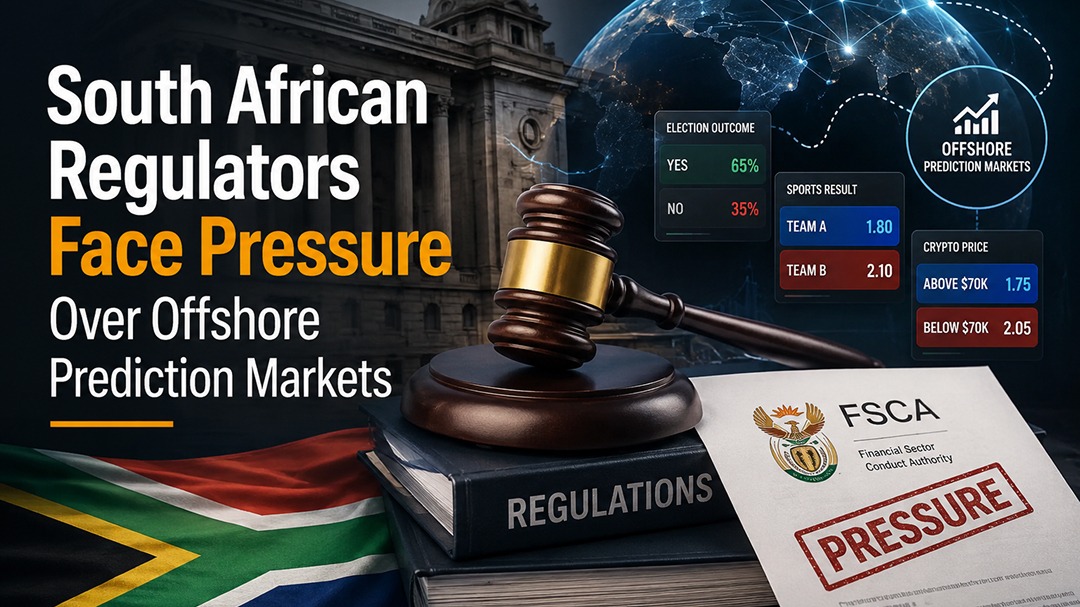
South African Regulators Face Pressure Over Offshore Prediction Markets
Calls are growing for South African gambling authorities to take a firmer position on offshore prediction markets, with the South African Bookmakers’ Association warning that these platforms may be offering betting-style products without the same rules applied to licensed local operators.
Prediction markets let users place money on the outcome of future events. These can include elections, political appointments, sporting results and financial developments. Although the platforms are often described as forecasting tools, SABA argues that their basic function is close to exchange betting.
The issue attracted attention after more than R700,000 was reportedly placed on Polymarket on the identity of Johannesburg’s next mayor. The platform was not operating under a South African gambling licence, raising questions about taxation, consumer protection and regulatory oversight.
Explore the Latest Betting Offers and Casino Promotions

Get up to R15,000 + 450 Bonus Spins


100% up to R5,000


50 Free Spins on Big Blue Fishing
200% match bonus up to R2000


R25 Free Bet On Sign Up



50 Habanero Bonus Spins & R50 When You Sign Up


100% bonus up to R3,000


30 Free Spins On Sign-Up
R35,000 Match Bonuses Over 3 Deposits.

20 Free Spins + R25 Free Sports Bet
Up to R30,000 across 5 deposits

R50 Sign Up Bonus plus 25 Free Spins On Sign-Up
1,500 to R5,000

100% Match Up To R3,000 + 50 Free Spins
1,400+ Games & 800+ Slots



100% Deposit Match Up to R3,000
100% Welcome Bonus Up to R3,000

100% to R5,000 + 250 free spins + R25 bonus bet
23 Sports Categories, 700+ Casino Games

250% Welcome Bonus up to R5,000
250% to R5,000 + 50 FS (BZC exclusive)

100% Welcome Bonus up to R5,000
100% to R5,000 + 50 Free Spins
Prediction Markets Fall Into a Legal Grey Area
South Africa does not currently have a dedicated licence for prediction-market operators.
This creates uncertainty over whether provincial gambling authorities can regulate these services through existing betting laws. Prediction markets usually allow users to take opposing positions on an event, with the operator providing the platform and collecting a fee.
That model differs from traditional bookmaking, where the operator sets the odds and accepts the financial risk attached to each wager. However, SABA maintains that the end product still involves staking money on an uncertain outcome.
The association believes operators should not be able to avoid gambling requirements by presenting their services as information markets or forecasting products. It has called for a wider review involving gambling law, financial regulation and election-related legislation.
Until clearer rules are introduced, SABA’s view is that offshore prediction markets should not be permitted to target South African users.
Offshore Platforms May Create Added Risks
The debate is not limited to licensing.
SABA has also raised concerns about the potential effect of prediction markets on the integrity of sport and public decision-making. A market linked to a sporting failure, political outcome or official appointment could create an incentive for individuals with inside information to profit from events they may be able to influence.
Sports betting operators in regulated markets are subject to monitoring and reporting requirements intended to identify suspicious activity. Prediction markets operating from outside South Africa may not be connected to the same local systems.
There are also concerns around financial crime. Some offshore platforms support crypto-asset payments and allow users from several countries to trade against one another. This can make it more difficult for local authorities to trace transactions, obtain customer records or enforce anti-money laundering controls.
These risks could potentially be managed under a formal regulatory system, but SABA argues that the required safeguards are not yet in place.
Licensed Operators Remain the Safer Choice for Players
The absence of local licensing may also leave South African users with limited options when disputes arise.
Regulated gambling companies are expected to follow responsible gambling rules, offer formal complaints procedures and comply with advertising and self-exclusion requirements. Offshore prediction markets may not provide access to the same protections.
There is also an economic concern. Operators based outside the country can generate revenue from South African users without necessarily paying local gambling taxes or contributing towards domestic responsible gambling initiatives.
SABA has therefore recommended that prediction markets be treated as a form of exchange betting, with any future licensing framework covering taxation, customer verification, financial monitoring, market integrity and player protection.
For South African players, the current uncertainty makes it important to consider how and where a gambling platform is regulated before depositing. A reviewed selection of online casinos can help players identify established options that are designed for the South African market and offer clearer information about payments, terms and responsible gambling controls.